
Running a Check in Hawaii
The Hawaii Sex Offender and Other Covered Offender Registry is the official starting point. HCJDC, a unit of the Hawaii Department of the Attorney General, maintains the central file. The free public service covers information that Chapter 846E makes public throughout Hawaii. It is broader than its familiar label may suggest. A covered offender can be a sex offender or an offender against minors, and a qualifying offense against a minor is not always sexual. The portal also separates offender type from registration status. Those two filters answer different questions.
The Hawaii registry says its data are updated nightly, but it also warns that an address or status may not be current. A name, photo, and general appearance do not prove identity. HCJDC states that positive identification requires fingerprints. Use the public profile to support personal and family safety, then compare multiple identifiers. If the question concerns a court judgment, check the nonconfidential Judiciary record as a separate source. For current custody, use the proper corrections or victim-notification channel. Each system records a different part of the Hawaii justice process.
Hawaii local reporting does not run through a single county sheriff model. Covered offenders generally report to county police chiefs and police departments, while designated Attorney General and State Sheriff locations also serve parts of Hawaii. The central Hawaii search spans the state, but the Hawaii county directory is the route to the correct local layer.
Why Hawaii Says Covered Offender
Hawaii uses “covered offender” as a defined legal term. It includes people convicted of listed sexual offenses and certain offenses against minors. The Hawaii definition can reach qualifying nonparental kidnapping or unlawful imprisonment of a minor, as well as specified exploitation, enticement, privacy, computer, and inchoate offenses. An inchoate offense is an attempt, solicitation, or conspiracy tied to a covered crime. Comparable federal, military, tribal, out-of-state, and foreign convictions may also qualify under HRS §846E-1.
This wording matters during a Hawaii registry search. The Offender Type field offers All, Sex Offender, and Offender Against Minor. A result under the last choice should not be relabeled as a sex offense without reading the underlying covered offense. Hawaii also excludes a juvenile Family Court adjudication from the statutory definition of conviction. One narrow public-access exception applies when the person has only one covered offense, that offense is a misdemeanor, and it was not committed against a minor. It is not a broad rule that hides every misdemeanor.
Note: Hawaii offender type describes the statutory basis for registration, while status describes current administration of the registration duty.
Searching the Hawaii Sex Offender and Other Covered Offender Registry
The live Hawaii registry search accepts name and geographic criteria without a login. A Google reCAPTCHA protects submission. Start narrowly when checking a known person, then try a lawful alias or spelling variation if needed. For an area check, the form supports street name, city, radius, and ZIP options. There is no current county or island field. An old set of instructions that mentions an island search does not match the inspected live form.
- Open the official Hawaii Covered Offender Search, read its warning, and choose the question you need to answer.
- Enter first and last name for a known person, or use Hawaii street, city, radius, or ZIP criteria for area awareness.
- Review Hawaii offender type and status separately. Compare aliases, year of birth, photograph, physical details, address, and offense data.
- Cross-check an out-of-state status through NSOPW, or use the Hawaii correction channel if a profile appears wrong.
The form’s geographic logic has a key limit. When Radius is selected, Hawaii says the ZIP Code field is ignored. A reader should not assume those two filters combine. Nor should a broad city result be treated as proof that every listed address is current. The status and last known public details still need close review.
| Field Label | Type | Required | Notes |
|---|---|---|---|
| Offender Type | Dropdown | No | The Hawaii default is All; Sex Offender and Offender Against Minor are separate choices. |
| Covered Offender Status | Dropdown | No | Hawaii offers All, Registered, Non-Compliant, Absconded, Confirmed Out-of-State, or Incarcerated. |
| First and Last Name | Text | No | The Hawaii portal publishes no minimum length or wildcard rule. |
| Street Name and City | Text | No | The Hawaii Street Name field has no separate street-number field. |
| Radius | Dropdown | No | Select 1, 2, or 3 miles; Hawaii ignores ZIP Code when Radius is used. |
| ZIP Code | Dropdown | No | All is the default; the Hawaii list includes state ZIP areas and an Unknown option. |
| E-Alerts | Separate signup | Account required | A myHawaii SSO account supports Hawaii area notices when information changes or a covered offender moves into the area. |
Hawaii Registry Geography Traps
Myth: a radius and ZIP search produce a tighter combined map. Fact: the Hawaii form ignores ZIP when Radius is used. Choose one method based on the question. Street name plus city and a one-, two-, or three-mile radius is useful for a defined area. City or ZIP can support a wider scan. Neither method changes the registry’s warning about the accuracy or present location of a listed person.
Status labels can also mislead. Registered does not mean low risk. Non-Compliant says that a required report, update, or verification is delinquent, not that a new offense occurred. Absconded signals a serious location or compliance concern, but the safe response is to contact HCJDC rather than confront anyone. Confirmed Out-of-State means Hawaii retains a record while another jurisdiction is tied to current registration. Incarcerated identifies custody status, which should be confirmed through the responsible custody system.
Hawaii has no statewide school or park residence-distance rule in Chapter 846E. The HCJDC FAQ likewise says there is no statewide restriction on where a covered offender may live or work. A court, probation officer, parole authority, treatment plan, or minor-contact condition can impose person-specific limits. Do not import another state’s buffer rule into a Hawaii address search.
What a Profile Shows
A Hawaii public profile is a statutory subset of the full registration file. Public fields can identify names and aliases, year of birth, physical description, marks, current or temporary residence, work location details, school affiliation, vehicles, covered offenses, judgments, and a recent photograph. Hawaii redacts victim identity. The full file may contain more sensitive identifiers, but public access does not extend to full birth date, Social Security number, telephone and email details, fingerprints, palm prints, DNA information, passport or immigration records, or the person’s complete criminal history.
| Name & Aliases | Current and prior names used in Hawaii, nicknames, pseudonyms, and aliases, with year-only birth information. |
|---|---|
| Photograph & Description | A recent photograph published by Hawaii, physical description, scars, tattoos, and other identifying marks. |
| Residence & Work | Current or temporary Hawaii residence, or an area description, plus public work street and ZIP details or routes. |
| School & Vehicles | Hawaii educational institution and affiliation dates, plus listed vehicle, watercraft, or aircraft details. |
| Offense & Judgment | Hawaii covered offense, judgment information, and the text or link for the law underlying the offense. |
| Status | Hawaii lists Registered, Non-Compliant, Absconded, Confirmed Out-of-State, or Incarcerated as an administrative status. |
A Hawaii registry profile is not the same as an eCourt Kōkua case file or an HCJDC criminal-history report. The Hawaii profile shows the public Chapter 846E fields. The court system supplies public docket and judgment context. An HCJDC history has its own disclosure limits. Comparing the correct official sources can resolve a date or disposition question without assuming that one record replaces another.
Hawaii Registry Alerts Across State Lines
Hawaii offers an address-area e-alert service through a myHawaii SSO account. The public description says an alert may follow an information update or a move into the selected area. Exact saved-address and radius fields sit behind the login, so they should not be guessed. A Hawaii alert can support ongoing neighborhood awareness. It cannot guarantee safety, current location, or an immediate warning for every change.
When a Hawaii search crosses state lines, the U.S. Department of Justice National Sex Offender Public Website brings together public searches from participating jurisdictions.
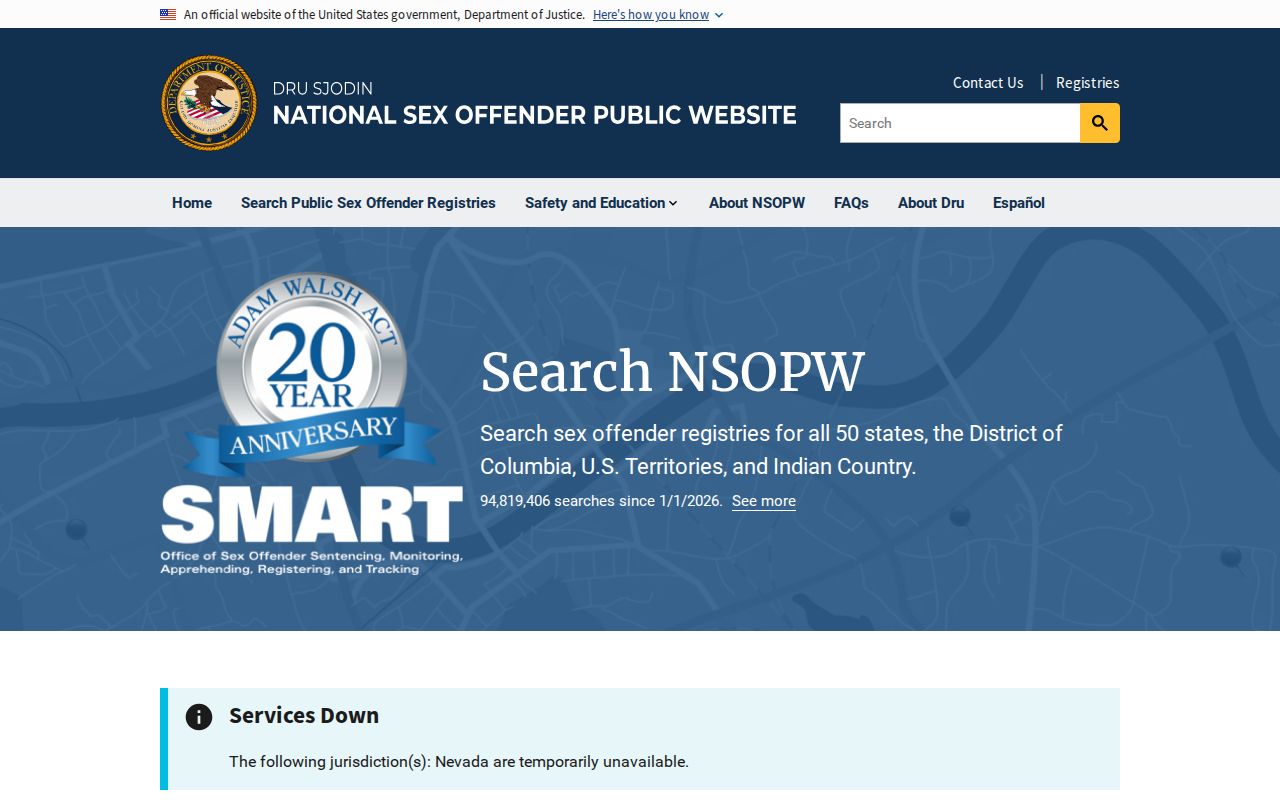
The national layer helps locate the destination registry, while Hawaii’s portal remains the source for Hawaii-specific profile terms, statuses, and Chapter 846E rules. A Confirmed Out-of-State result is a sound reason to use both NSOPW and the destination state’s registry. If the issue is custody rather than registration, use Hawaii SAVIN/VINELink, DCR, or the federal Bureau of Prisons as appropriate. A separate Hawaii bulk public-registry download requires a login and costs $100 per download.
Registration Requirements and Levels
Hawaii registration is a lifetime duty unless a court grants termination through a civil petition. Tier 1 and Tier 2 time periods are the earliest petition points, not automatic expiration dates. Tier 3 and repeat-covered-offender categories ordinarily carry lifetime registration, though a separate forty-year petition path may apply. Under HRS §846E-10, the court must assess eligibility, substantial compliance, future-offense likelihood, and whether continued registration assists public safety.
| Level / Tier | Duration | Verification Frequency |
|---|---|---|
| Hawaii Tier 1 | Lifetime unless terminated; earliest ordinary petition in Hawaii after 10 clean-record years outside custody or commitment. | Annual in-person update in Hawaii, plus quarterly verification and prompt change reports. |
| Hawaii Tier 2 | Lifetime unless terminated; earliest ordinary petition in Hawaii after 25 clean-record years outside custody or commitment. | Annual in-person update in Hawaii, plus quarterly verification and prompt change reports. |
| Hawaii Tier 3 | Lifetime; ordinary tier petition unavailable, with a limited forty-year petition route in Hawaii. | Annual in-person update in Hawaii, plus quarterly verification and prompt change reports. |
| Hawaii Repeat Covered Offender | Lifetime, subject to Hawaii’s same-event counting rule and limited forty-year petition route. | Annual in-person update in Hawaii, plus quarterly verification and prompt change reports. |
A clean record has a specific Hawaii meaning. It includes no new felony or covered-offense conviction, successful probation or parole with no more than one revocation, and completion of ordered treatment where applicable. If a petition is denied, another petition is barred for five years. Recommitment for a supervision violation can pause the time calculation. Also, ending public website access after forty years is not necessarily the same as ending the underlying registration duty.
Hawaii Registry Reporting Routes
Hawaii’s reporting schedule is strict. Initial in-person registration is generally due within three working days after a triggering arrival, release, conviction, probation or parole placement, or county presence. A nonresident can trigger registration after more than ten days in Hawaii or more than thirty days in the aggregate during a year. Covered offenders report changes in writing within three working days. An absence from a registered residence for ten or more days also becomes reportable.
The Hawaii annual in-person review occurs during the thirty days after a birthday and includes a current photograph. Hawaii’s quarterly verification runs in January, April, July, and October. People with a deliverable permanent address receive a nonforwardable form and must return it within ten days. A person with a temporary or nondeliverable address and no post-office box reports in person during the first week of those months. Failure to perform a required registration, update, or verification, or supplying false data, is a Class C felony under HRS §846E-9.
The Hawaii HCJDC registry program notice records an important operational change and identifies the statewide program.
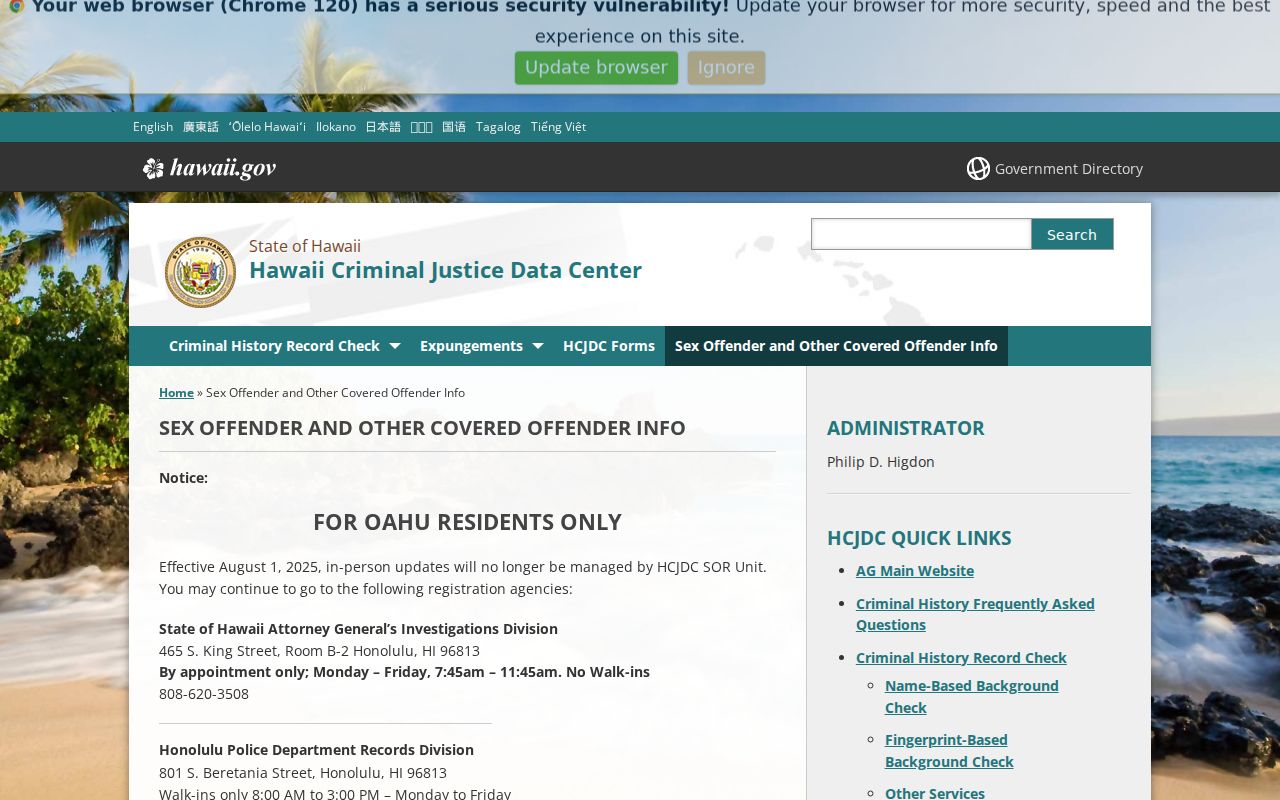
The image reflects HCJDC’s continuing central role. Since August 1, 2025, its former Oʻahu in-person update counter no longer handles those updates. AG Investigations accepts appointments, and HPD Records offers the walk-in channel. HCJDC still maintains the registry and answers registry questions. Elsewhere, Hawaii uses county police and designated State Sheriff offices. Hawaii also lists public search terminals across the islands. Hours and exact routing can change, so confirm the local office through the county directory before a visit.
Lawful Use
Hawaii publishes covered-offender information for public awareness. Disclosure in Hawaii rests on a conviction or covered designation, not a prediction that a person will cause harm. The Hawaii search can inform personal, family, and community safety choices. It does not authorize threats, harassment, injury, confrontation, or vigilantism. The Attorney General may provide public information to a person or organization seeking notification under Hawaii agency procedures, and the e-alert system is the practical public channel.
Misuse can lead to prosecution. Hawaii warns that using registry information to injure, harass, or commit a crime may create criminal prosecution, civil liability, or both.
Call HCJDC or the designated Hawaii registration office if a public status suggests a compliance issue. Do not approach the listed person. A Hawaii public record may be incomplete or out of date, and any urgent safety threat belongs with law enforcement. These boundaries preserve the registry’s safety purpose while reducing the risk of harm from an unverified assumption.
Correcting Hawaii Registry Information
If a Hawaii profile appears wrong or stale, first capture the public field in question and compare it with the official offense, judgment, or status source. A listed person may petition the Attorney General to correct erroneous public information under HRS §846E-3(d), with appeal rights under Chapter 91. A member of the public can report possible nonregistration or inaccuracy to the HCJDC Sex Offender Registry Unit or the designated local registration office. Do not try to correct the record by contacting the registrant.
Use the Hawaii channel that owns the disputed fact. HCJDC maintains the central registry. The local registration office receives reports and updates. A Hawaii court owns its judgment and docket. Corrections and federal systems own custody facts in their files. This division explains why one source can lag another without proving misconduct. It also gives a clear path in Hawaii: identify the field, find its source, report the mismatch, and recheck after the responsible office has reviewed it.
Note: A nightly Hawaii registry update cycle does not guarantee that a newly reported change appears at once or that every address is current.