
How to Check Criminal History in Hawaii
Begin with the question the record must answer. HCJDC eCrim is the public statewide route for Hawaii adult conviction information. eCourt Kōkua is better for a filed criminal case, its docket, disposition, and available court documents. Hawaii SAVIN/VINELink tracks participating custody status and alerts. The county police department remains the source for the original arrest or incident report. These systems overlap, but none replaces the rest.
Gather the person's full name and lawful identifying details before searching. A date of birth can help narrow a common name. Case ID, arrest number, OTN, TCN, or Hawaii SID may connect records that otherwise look separate. Read the disposition, not just the charge. If the issue is identity accuracy, use HCJDC's fingerprint-based Access and Review process for your own Hawaii criminal history rather than treating a name match as proof.
- Choose eCrim for a public adult conviction summary or eCourt Kōkua for a filed Hawaii case.
- Enter the strongest lawful identifiers available and keep track of the record numbers returned.
- Use the county directory for the police report, local arrest log, or island-specific records route.
- Check the final court disposition and compare identifiers before linking a result to a person.
- Order a certified report or fingerprint-based self-review only through the official channel that offers it.
Search Hawaii eCrim Carefully
eCrim requires a State SSO account. A unique search costs $5 within one login session, and an official electronic report costs another $12 after a result is selected. The session clears searches and cart items after 30 minutes of inactivity. A valid search can return “No Criminal Convictions Found.” That message describes the public conviction product. It does not prove there was no pending case, confidential non-conviction arrest, juvenile matter, federal case, or record outside Hawaii.
| Field | Type | Required | Use |
|---|---|---|---|
| Name | Text group | Functionally central | Primary person search; exact subfields appear after login |
| Date of birth | Date or text | Optional | Narrows people with similar names |
| Social Security number | Text | Optional | Sensitive narrowing identifier |
| Gender | Choice | Optional | Options appear after login |
| State SSO login | Authentication | Yes | Required before any paid search |
The HCJDC fee and name-check source shows the current options. The captured source below gives readers a visual reference for the public fee route.
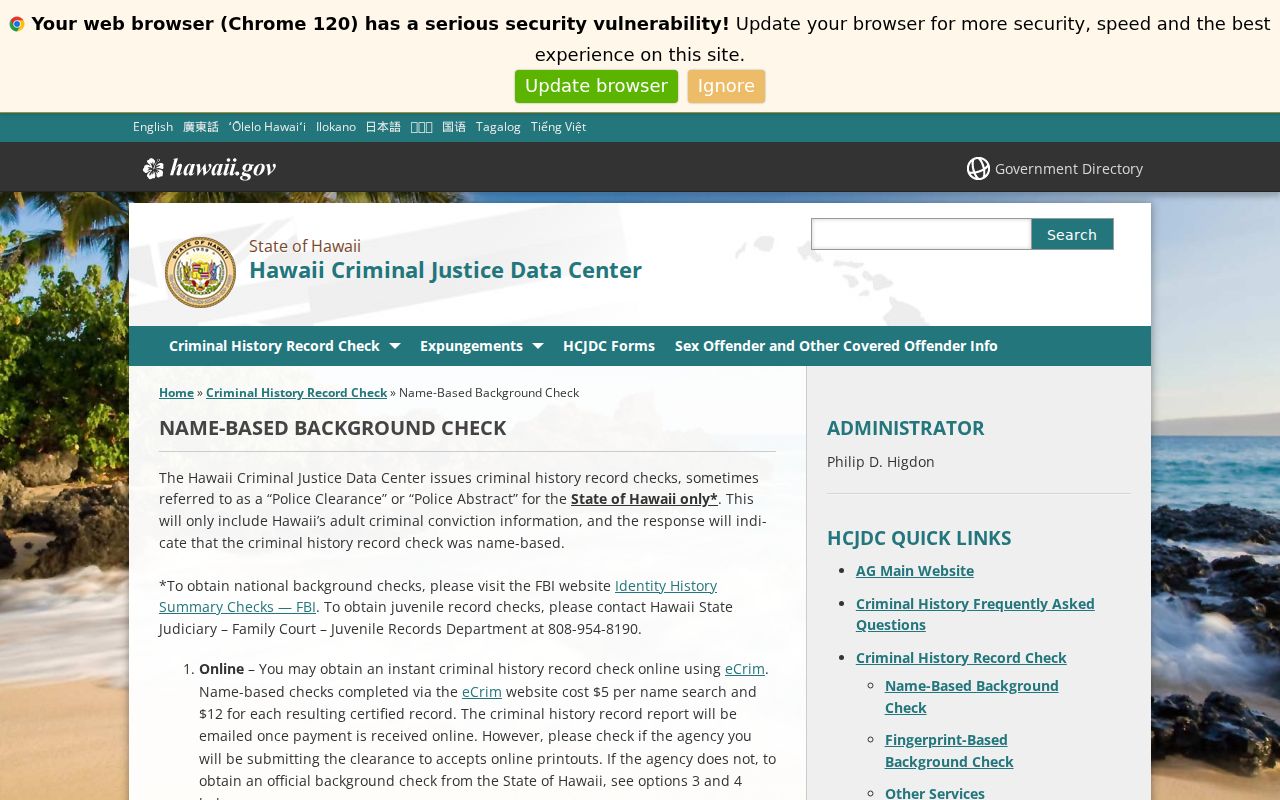
The image reinforces the key choice: use the lower-cost online search for public conviction data, or select a staffed product when its format is needed.
Note: Keep the search and report purchase in one eCrim session because inactivity clears the result and shopping cart after 30 minutes.
The Hawaii Criminal History Repository
The Hawaii Criminal Justice Data Center, or HCJDC, sits within the Department of the Attorney General. It operates CJIS-Hawaii, the statewide fingerprint identification system, eCrim, and the covered-offender registry. Arresting agencies, prosecutors, and Hawaii courts contribute different parts of a record. Fingerprints and charges begin with the arrest cycle. Prosecutors and courts later supply charging and disposition data. HCJDC links those parts into a statewide criminal history.
Public access is narrower than the full repository. eCrim focuses on Hawaii adult convictions and specified Chapter 704 outcomes. Pending and most non-conviction arrest information is not open to the general public through that product. A person may review their own fuller record through Access and Review with fingerprints. The HCJDC criminal history agency profile compares each product, fee, order method, and correction path.
How Hawaii Records Reach HCJDC
A Hawaii arrest can create several records at once. County police or another authorized agency creates the incident report. A custodial booking adds fingerprints, a photograph, charges, bail or hold data, and transaction identifiers. The Hawaii Judiciary creates a separate case when charges are filed. Final dispositions then flow back to CJIS-Hawaii and should attach to the correct fingerprint-supported arrest cycle.
Arrest → Booking → Fingerprint submission → Court case → Final disposition → HCJDC rap sheet
Timing and source errors can break the chain. HCJDC warns that it cannot guarantee every contributing agency submitted every item accurately or completely. HRS §846-5 sets an outside 90-day disposition-reporting deadline, while data-integrity staff research missing outcomes. Compare a disputed HCJDC entry with the eCourt docket and the source police or courthouse record. Note: A short reporting lag can make two official Hawaii systems disagree without making either screen a complete history.
Statewide Record Systems in Hawaii
Hawaii combines county policing with state courts and state correctional facilities. That structure differs from the sheriff, county clerk, and county jail model used in many states. One Hawaii criminal history search may therefore touch a county police department, the unified Hawaii Judiciary, HCJDC, and the Department of Corrections and Rehabilitation. The system chosen should match the kind of fact being checked.
DCR does not advertise a separate statewide name-search inmate locator. Hawaii SAVIN/VINELink is the public status and notification route, with facility and records contacts as fallbacks. The covered-offender registry is free and separate from eCrim. eCourt Kōkua provides statewide case indexing, but old cases, confidential matters, and documents without a PDF icon may require a courthouse request.
| System | What It Holds | Run By |
|---|---|---|
| Adult Criminal Conviction Information, eCrim | Public Hawaii adult conviction information | HCJDC |
| Hawaii SAVIN/VINELink | Participating custody status and alerts | Hawaii DCR |
| Sex Offender and Other Covered Offender Registry | Public Chapter 846E registry data | HCJDC |
| eCourt Kōkua | State court dockets and available documents | Hawaii State Judiciary |
Hawaii Jail and Prison Records
Hawaii DCR operates both community correctional centers and prisons. Community centers hold many pretrial and shorter-term populations; prisons hold longer sentenced populations. That means the usual county-jail versus state-prison split is an agency distinction inside one state department, not a split between a sheriff and DCR. A December 31, 2025 report counted 2,822 people physically housed in listed Hawaii facilities and 3,676 total assigned when mainland placement was included.
Use Hawaii SAVIN/VINELink for participating custody status and notification. Confirm urgent or current facts with the facility because releases and transfers can change. DCR's population reports are aggregate, not a person locator. Federal custody remains separate through the Federal Bureau of Prisons. A court docket may show the legal custody order, but it should not be treated as live proof of a present location.
Note: Hawaii's state-run jail structure changes the custodian, but the county where the arrest occurred still identifies the local police record.
Types of Criminal Records
“Criminal record” can mean several records with different custodians. Hawaii criminal history research works best when each term stays tied to its source. An arrest report tells what police documented. A booking entry reflects intake and custody. A court file tracks allegations, motions, hearings, and the result. An HCJDC rap sheet compiles reported arrest cycles and dispositions under dissemination rules. Registry and supervision records answer other, narrower questions.
- Arrest and booking records come from the arresting agency and DCR intake process.
- Criminal court case files are Hawaii Judiciary records that may include complaints, motions, dockets, and judgments.
- Repository rap-sheet entries link fingerprint-supported cycles and reported final dispositions through HCJDC.
- Warrants arise from a court or authorized process and have no verified all-Hawaii public name list.
- Probation, parole, and registry records come from the Judiciary, Hawaii Paroling Authority, DCR, or HCJDC according to the record.
- OTN
- An offense tracking number tied to an arrest cycle.
- SID
- A Hawaii state identification number used to associate fingerprint-supported history with one subject.
- Disposition
- The recorded outcome of a charge, such as guilty, dismissed, acquitted, or declined.
- Rap sheet
- A compiled criminal history record, not the same as the court's original case file.
A charge can be amended before disposition, and the offense grade on an arrest entry may differ from the final judgment. Always read both stages.
Hawaii Has No Public Warrant List
No official all-Hawaii public warrant name search was verified. The public trail is split between the issuing state court and the county or state law-enforcement agency that may execute the warrant. eCourt Kōkua can show docket events related to a bench warrant, bail, recall, or return when the event is public. Active operational detail may be withheld for safety or an investigation, and juvenile or sealed matters remain restricted.
If a Hawaii warrant may concern you, search the case first, then contact the correct courthouse and official police channel. Counsel can help plan a safe appearance when arrest is possible. A UIPA request does not force release of protected operational facts. Do not rely on a commercial warrant list or assume a missing online entry means no warrant exists. The later recall or return order is the record that confirms the status changed.
Hawaii Probation and Parole Split
Adult probation is a Hawaii Judiciary function administered through Adult Client Services in each judicial circuit. It is not a county-government probation department. No official statewide public probationer name portal was located. A public court docket and judgment can show the probation sentence or later violation event, while the correct circuit office holds the supervision file and answers authorized questions.
Parole runs through the Hawaii Paroling Authority, which is attached to DCR. Hawaii SAVIN/VINELink may show a public custody or parole status and offer notifications, but it does not replace the full HPA file. The 2024 State Data Book reported 997 parolees and 1,537 consideration hearings. Those are annual measures, not a current name roster. Court, HPA, DCR, and VINELink records should be read as distinct sources.
Note: Interstate supervision does not move the underlying Hawaii judgment out of eCourt Kōkua or transfer the source case to another state.
Public Access Laws
The Hawaii Uniform Information Practices Act, HRS Chapter 92F, starts with a right to inspect government records unless another law closes access. It also permits withholding for privacy, active enforcement, frustration of a legitimate government function, or another legal restriction. Criminal-history dissemination has its own limits under Chapter 846. Public adult conviction data may be available even when pending and ordinary non-conviction arrest history remains confidential through eCrim.
Key Statutes:
HRS Chapter 92F creates UIPA access rights and the main exemptions for state and county records.
HRS Chapter 846 governs HCJDC, criminal-history collection, reporting, quality, and dissemination.
HRS §831-3.2 provides the main expungement route for qualifying non-conviction arrest information.
HRS Chapter 846E controls covered-offender registration, public fields, duties, and penalties.
UIPA requests go to the office that maintains the record. OIP supplies forms and handles access disputes, but it does not hold another agency's file.
Hawaii Expungement Is Not Sealing
HRS §831-3.2 allows a person arrested for or charged with an offense, but not convicted, to apply to the Attorney General when the statutory conditions are met. HCJDC reviews the arrest and case data. If approved, it issues a certificate and removes the eligible arrest information from public criminal-history dissemination. The first application costs $35, a later application costs $50, and a duplicate certificate costs $20. The current form calls for identification, a stamped return envelope, and any required court order.
An HCJDC certificate does not itself seal every Judiciary record. The court file may need a separate judicial sealing process. Act 3 of 2025 now links qualifying HCJDC transmission to Judiciary consideration of public electronic records, but the court still considers the statutory limits. The official HCJDC expungement source shows the active process.
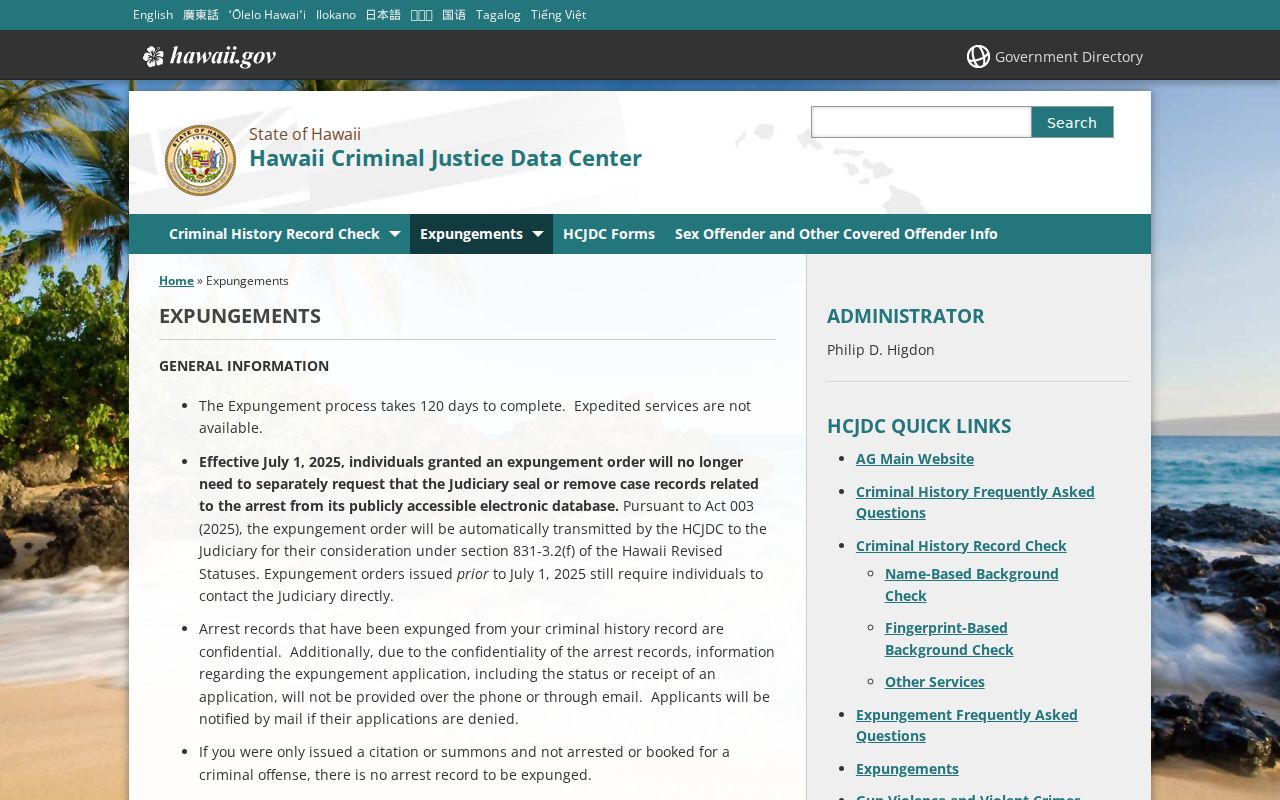
The captured page underscores the two-part follow-up: confirm the HCJDC result, then check whether a separate court record remains public.
Hawaii Police Reports Stay Local
No statewide portal pools every county police report. A request goes to the agency that created the record. Include the report number when known, event date and location, involved names, and the exact material sought. Under UIPA, the agency may redact victim, juvenile, medical, security, or active-investigation details. Ask for a cost estimate and the legal basis for any denial. A crash report, incident report, arrest record, court file, and HCJDC history are not interchangeable.
The Office of Information Practices form source supplies a standard request-to-access-government-records form and appeal resources. State Department of Law Enforcement records use a separate UIPA channel. County police departments set their own submission routes and lawful copy charges, which is why the directory matters for local Hawaii criminal records.
Hawaii Record Fees Compared
Costs depend on the source and the document. eCourt Kōkua basic case data is free, but available PDFs cost $3 for the first 30 pages and ten cents for each extra page. A quarterly subscription costs $125. Hawaii SAVIN/VINELink and an individual registry search are free. HCJDC counter payments can include a three percent electronic service fee, while mailed HCJDC requests require a money order or cashier's check.
| Hawaii record product | Current fee | Channel |
|---|---|---|
| eCrim unique search | $5 | Online eCrim |
| eCrim official report | $12 additional | Online after selecting a result |
| Public-access printout | $25 | HCJDC or designated police site |
| HCJDC staff name check | $30 | Counter or mail |
| HCJDC fingerprint check | $55 office or $35 mail | Official self-review or authorized route |
| Certification | $20 | Add-on to an eligible HCJDC result |
The official public-access-site roster identifies the island locations that supply the $25 statewide conviction printout.
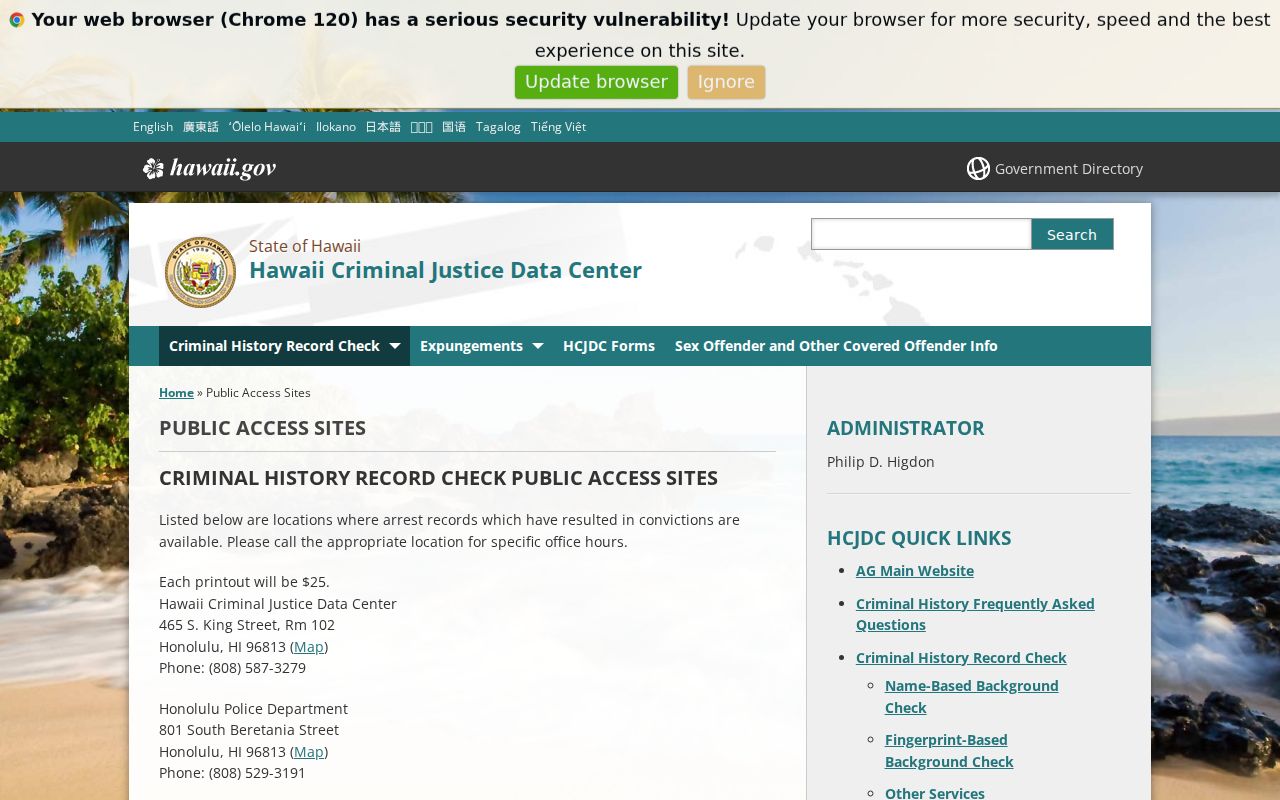
The captured roster shows why a police-station terminal still returns a statewide HCJDC product rather than only that department's arrest files.
Note: An HCJDC certification applies to the eligible repository result and does not certify a separate Hawaii court document.
Find Criminal Records by County in Hawaii
Hawaii has five county-equivalent folders in this project. Four organized counties provide the main local police routes, while Kalawao is a state-administered quasi-county without the usual local government stack. Courts remain part of the unified state Judiciary, yet cases still route through the First, Second, Third, or Fifth Circuit. These county links lead to local detail for police reports, arrest logs, custody contacts, and the correct island court route.
City and County of Honolulu
Honolulu · Largest county police, jail, First Circuit, and HCJDC service center
Hawaii County
Hilo · Third Circuit, island police, HCCC, and two public-access sites
Maui County
Wailuku · Second Circuit, Maui Police, and MCCC records route
Kauai County
Līhuʻe · Fifth Circuit, Kauai Police, KCCC, and public-access site
Kalawao County
Kalaupapa area · State-administered quasi-county with special routing
Browse the full directory of all 5 Hawaii counties to open the criminal records site for every available county route.
Hawaii Crime Counts Are Not Histories
The Crime in Hawaii program and NIBRS dashboard publish aggregate incident and arrest measures. They help show patterns by time, offense, location, and reporting agency. They do not provide a person-level Hawaii criminal history search. An arrest count is not a conviction count, a court caseload, a DCR admission total, or the number of people in HCJDC. Reporting transitions and agency participation also affect comparisons across years.
The official Crime in Hawaii source links the state's reports and dashboard context.
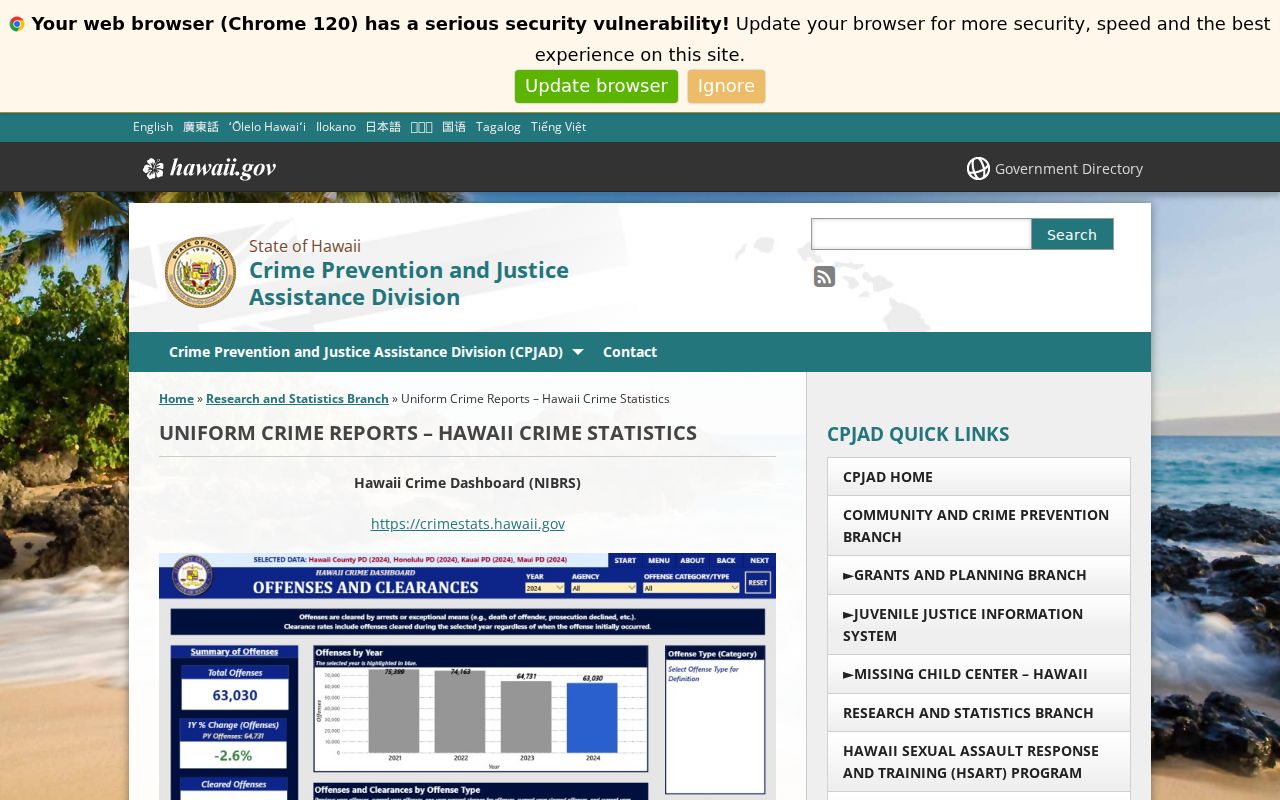
The captured source is useful for statewide context, while eCrim, eCourt Kōkua, and local agency records remain the channels for an identified case or person.