
About the State of Hawaii Department of the Attorney General – Hawaii Criminal Justice Data Center
The Hawaii Criminal Justice Data Center is the criminal-history and identification office within the Hawaii Department of the Attorney General. HRS Chapter 846 provides the legal framework for the data center and Hawaii's statewide criminal-justice information system. HCJDC is also the state's FBI CJIS Systems Agency. That role includes system access, training, security enforcement, technical support, upgrades, and audits for authorized users.
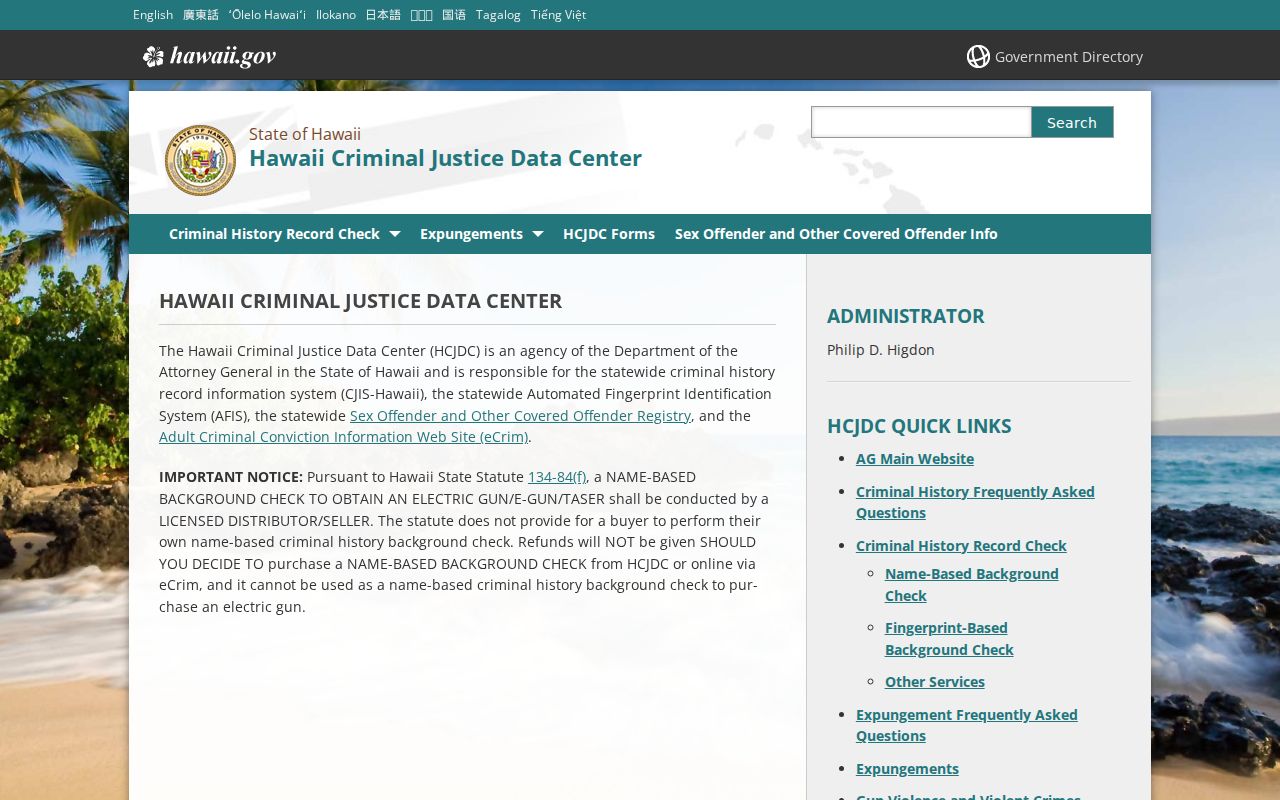
The official agency view places criminal-history checks alongside fingerprint identification, the covered-offender registry, and CJIS-Hawaii support. HCJDC is led by an administrator, so the office remains the stable reference even when named officials change. The Attorney General's Crime Prevention and Justice Assistance Division separately runs Crime in Hawaii statistics. Aggregate crime reporting should not be attributed to the repository unit merely because both offices share a parent department.
Four HCJDC Criminal History Systems
HCJDC connects four major statewide systems, each with a different job. CJIS-Hawaii stores criminal-history record information submitted by justice agencies. The Automated Biometric Identification System, often described through its AFIS roots, compares fingerprint identity. Adult Criminal Conviction Information, branded as eCrim, is the narrower public name-search product. The Hawaii Sex Offender and Other Covered Offender Registry is a separate public service governed by Chapter 846E.
| HCJDC system | Core function | Public scope |
|---|---|---|
| CJIS-Hawaii | Links arrest cycles, identity, charges, and reported dispositions | The full repository is not an open public database |
| ABIS/AFIS | Matches fingerprints and supports reliable identity decisions | Used through authorized or subject-review channels |
| eCrim | Searches Hawaii adult conviction information | Public with eHawaii SSO login and payment |
| Covered-Offender Registry | Publishes information allowed by HRS Chapter 846E | Free public registry search, separate from eCrim |
Official budget records show the scale without treating unlike measures as one count. The FY2025-27 plan reports more than 17 million CJIS-Hawaii records and more than 764,000 ABIS fingerprint records. FY2023-24 measures list 638,544 persons with criminal records and 662,624 public or web transactions. A record, a fingerprint identity, a person, and a transaction are different units.
Note: eCrim and the covered-offender registry are separate HCJDC searches with different laws, fields, fees, and permitted public information.
Criminal History Checks Offered by HCJDC
HCJDC offers public name products, fingerprint-based identity products, and subject-only review. The right choice depends on scope. eCrim is fast but limited mainly to Hawaii adult convictions. A fingerprint check can establish whether the record belongs to the person, while the information released still depends on the law or program that authorizes the request. Access and Review is the direct route for checking one's own fuller Hawaii file.
| Product | Who may order | What it returns | Cost |
|---|---|---|---|
| eCrim unique search | Public user with eHawaii SSO | Search outcome and viewable adult conviction matches | $5 |
| eCrim official report | User after selecting a result | Official electronic adult-conviction report | $12 more |
| Public-access printout | Public requester at a listed site | Adult arrests that resulted in convictions | $25 |
| Embossed name check | Public requester by counter or mail | Hawaii-only adult conviction information | $30 |
| HCJDC fingerprint check | Subject or authorized statutory channel | Fingerprint-associated Hawaii history allowed for that purpose | $55 in person or $35 by mail |
| Access and Review | Subject of the record | Own record for accuracy review and challenge | Applicable fingerprint or card fees |
| Fingerprint card service | Person needing an official card | Rolled fingerprints, not a record result by itself | $25; $5 scan item where applicable |
| VECHS result | Approved qualified care entity | Program-authorized Hawaii and FBI result | Program fee shown after approval |
Certification costs $20, while eligible notarization is listed at no charge and takes longer. HCJDC also has a wrongful-use fingerprint review when another person's arrest may be tied to the subject's name or Social Security number. The $55 office or $35 mail charge is refunded if misuse is verified. Subscriptions, government recurring checks, Rap Back, and bulk registry downloads are specialized services with their own eligibility rules, not substitutes for public eCrim.
HCJDC eCrim Has Two Fees
The HCJDC eCrim workflow separates searching from buying an official report. An eHawaii SSO user pays $5 for each unique search in the same login session. Search criteria can include a name and may include date of birth, Social Security number, and gender. The public page does not expose every required field before login, so optional details should not be described as mandatory.
After payment, the user opens View Search Results. Selecting a matching record and adding it to the cart creates the option to pay another $12 for the official electronic report. The report is emailed. Thirty minutes of inactivity clears searches and cart items, so the steps must stay in one session. A “No Criminal Convictions Found” result is valid, but it does not rule out pending arrests, non-conviction cycles, juvenile matters, federal records, other-state events, or registry information.
How Records Flow Into the HCJDC Repository
County police and other agencies with arrest powers create the source arrest record. When booking includes livescan fingerprints, identity and arrest data move into HCJDC systems. Prosecutors add charging decisions, and the unified Hawaii State Judiciary creates the case and judgment. The court or responsible agency then reports the final disposition so HCJDC can link it to the correct fingerprint-supported arrest cycle.
Data flow: County Arrest › Fingerprint Submission › State of Hawaii Department of the Attorney General – Hawaii Criminal Justice Data Center › Court Disposition Reporting › Rap Sheet
“Final disposition” means more than conviction. HCJDC policy recognizes results such as dismissal, acquittal, declined prosecution, guilty, and informational no-charge outcomes. Public eCrim still releases a narrower slice, chiefly adult convictions plus specified Chapter 704 results. The repository can hold a lawful nonpublic outcome even though a general eCrim user cannot see it.
Why HCJDC Records Have Gaps
HCJDC makes reasonable efforts to collect required information, but its policy does not guarantee that every contributing agency submitted every fact correctly or completely. A name-only event may fail to match a fingerprint identity. A disposition may arrive late or attach to the wrong cycle. HRS §846-5 sets an outside 90-day deadline for disposition reporting, while other Chapter 846 provisions require monitoring and audits.
The HCJDC Data Integrity function researches missing dispositions through court calendars, arrest reports, and source systems. It can correct repository information within its authority and work with contributors on interface errors. The best reader check uses the OTN, SID, fingerprint transaction number, police report number, and court case ID when available. Those identifiers help distinguish a late update from a wrong-person match.
Note: A missing HCJDC disposition does not prove a case remains open; compare the Judiciary docket and obtain the source court order.
How to Order a HCJDC Check
HCJDC accepts online, counter, mail, and fingerprint channels. Choose based on the record needed. Public adult conviction information can come from eCrim, a public-access site, or an embossed HCJDC name check. Identity certainty or review of one's own fuller file calls for fingerprints. A purpose-bound Fieldprint program requires the exact code supplied by its sponsoring Hawaii agency.
- Choose eCrim, a public printout, an embossed name check, a fingerprint check, or Access and Review based on scope and identity needs.
- Gather the required identifiers, HCJDC-073 form, identification, consent or program documents, and fingerprints where the channel requires them.
- Submit through eCrim, an HCJDC counter or public-access site, mail, or the exact Fieldprint channel directed by an authorized program.
- Pay the published fee. Counter payment excludes cash, and mailed HCJDC payment uses a money order or cashier's check payable to the State of Hawaii.
- Read the result within its scope. Pull the source police report or court file when an entry needs details, certification, or a final disposition.
An embossed name check is posted at three to five business days. A notarized request takes seven to ten business days. Counter electronic payments carry a 3% nonrefundable service fee. Program-specific Fieldprint totals vary, so do not reuse another agency's code or fee.
Note: A Fieldprint code controls the authorized destination and scope, so use only the code supplied by the sponsoring Hawaii program.
HCJDC Forms and Payment Choices
The HCJDC forms hub groups criminal-history and expungement requests under the agency that acts on them. HCJDC-073 provides choices for name-based search, fingerprint-based search, fingerprint services, card scan, Access and Review, wrongful use, certification, and notarization. It asks for the subject's name and aliases, date of birth, identifying information, contact details, signature, and fingerprints when the service needs them.
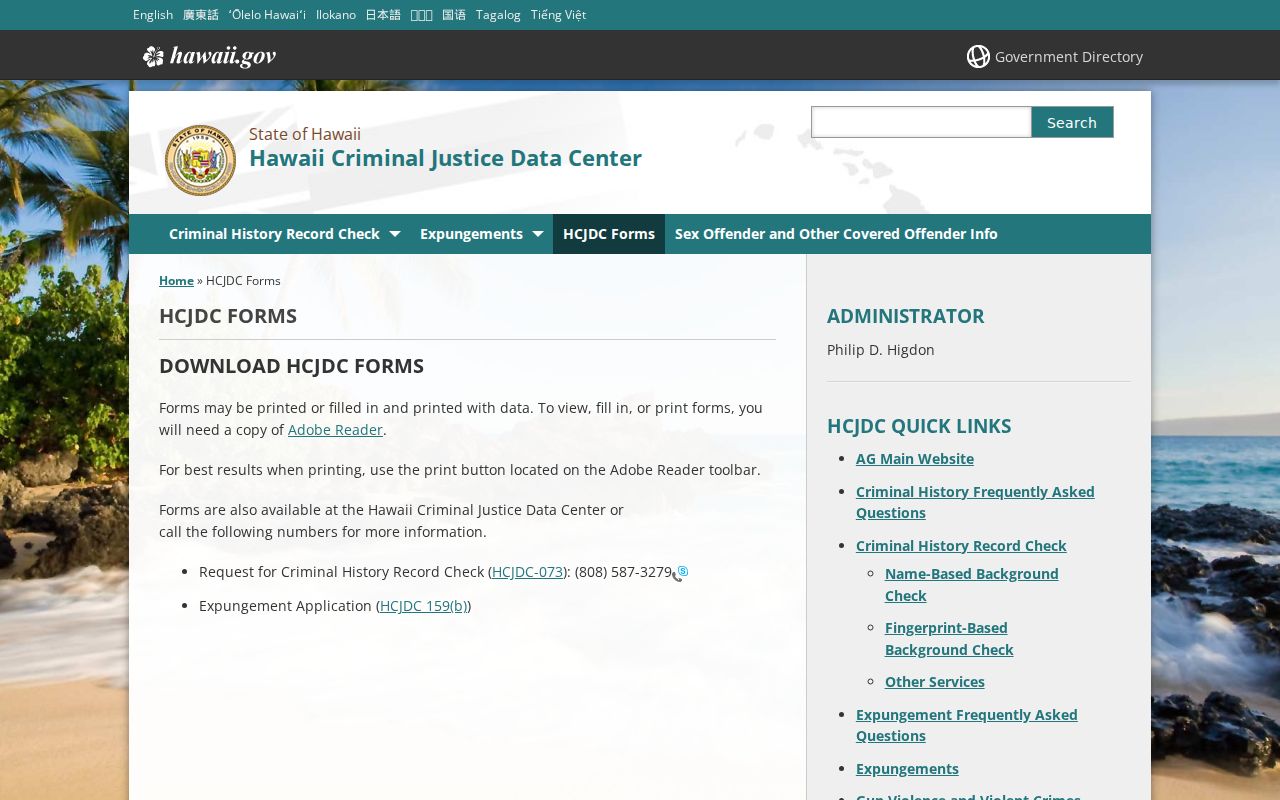
The official forms image helps separate a record request from a relief application. HCJDC-073 orders or reviews history. The current expungement application seeks a legal determination for eligible arrest information. Current web instructions control if an older saved form conflicts with the agency page. Mail requests do not accept cash, personal checks, or ordinary business checks.
HCJDC Checks vs County Records
An HCJDC check compiles reported information from across Hawaii. It is efficient when a person needs a statewide public conviction summary or a fingerprint-linked review of their own file. A county police report and the Judiciary case file answer different questions. They show the original narrative, filings, orders, and documents that a rap sheet condenses or omits. Use the directory of all 5 Hawaii counties to route to the police and circuit source for the island where the event began.
| HCJDC check | County and circuit records | |
|---|---|---|
| Coverage | Reported Hawaii history across all counties | One arresting agency or Judiciary circuit file |
| Identity | Name-based or fingerprint-supported, depending on product | Event and case identifiers tied to source documents |
| Freshness | Depends on contributor submission and matching | Updated as the arrest or case moves |
| Detail | Compiled entries or public conviction summary | Report narrative, docket, motions, orders, and judgment |
| Best use | Statewide summary or own identity-based review | Confirming what happened and how the case ended |
Neither source replaces the other. A case may appear in eCourt Kōkua before its disposition reaches HCJDC. An HCJDC cycle may contain identity data not published in the public court portal. Compare both when accuracy matters.
HCJDC Criminal History Milestones
Hawaii built the modern repository in stages. Act 129 created the statutory data-center structure in 1979, and Act 78 consolidated crime-statistics and civil-identification functions in 1983. Act 380 established computerized fingerprint identification in 1987. The 2001 Green Box pilot joined booking data, live fingerprints, and mug photography, then CJIS-Hawaii entered production in November 2002 and replaced the older OBTS/CCH environment.
- 2005
- eCrim launched around-the-clock public adult conviction access and online report payment.
- 2006
- Hawaii implemented the National Crime Prevention and Privacy Compact, with HCJDC as repository and compact officer.
- 2007-08
- The Lights Out Transaction Controller automated demographic and fingerprint identity decisions.
- 2014
- Act 196 created Hawaii's VECHS program for approved qualified care entities.
- 2025
- Act 3 connected qualifying HCJDC expungement orders with Judiciary consideration of public electronic records.
The history explains why one request may cross old and new systems. Legacy arrest cycles, modern fingerprints, and court entries can use different identifiers. A current correction may require both a repository update and action by the office that keeps an older source document.
Note: Historical scale and automation figures describe their cited year, not the current completeness rate of every HCJDC criminal-history cycle.
Correcting Errors in Your HCJDC Record
HCJDC Access and Review lets the record subject inspect their own identity-linked Hawaii history and challenge inaccurate or incomplete information. Common problems include a missing disposition, an arrest connected to the wrong identity, or an eligible entry that has not been updated after relief. Fingerprints establish the subject before the agency releases the fuller review product.
- Contact the HCJDC Criminal History Record Check Unit and select Access and Review on HCJDC-073, following its fingerprint and identification directions.
- Compare each identifier, arrest cycle, charge, and disposition with the police source and certified Judiciary record from the circuit that handled the case.
- Submit the challenge and supporting dismissal, amended judgment, or other certified document to HCJDC. The contributing agency may need to correct source data.
- Request or inspect a fresh HCJDC record after correction, then separately check any court PDF or police document controlled by another office.
Wrongful-use review is different. It asks whether fingerprints show that another person used the subject's name or Social Security number. A disposition challenge accepts the identity but disputes what happened to the case. Choosing the correct path avoids delays.
HCJDC Expungement and Court Sealing
Under HRS §831-3.2, a person arrested or charged but not convicted may apply to HCJDC when the statutory conditions are met. Common qualifying outcomes include no charge, dismissal, or acquittal, subject to exceptions. The first application costs $35, a later application costs $50, and a duplicate certificate costs $20. Each application fee includes a $10 nonrefundable processing part.
Use the June 2026 application. It requires government photo identification, a stamped self-addressed envelope, and any applicable court order. HCJDC reports about 120 days for ordinary processing and offers no expedited path. If approved, HCJDC issues a certificate and removes eligible arrest information from public criminal-history dissemination.
Expungement does not by itself seal every court document. Act 3, effective July 1, 2025, directs HCJDC to transmit qualifying orders for separate Judiciary consideration of public electronic records. Older files and multi-charge cases may still need direct court follow-up. Confirm the HCJDC entry and the eCourt Kōkua case rather than assume one action changed both systems.
Note: An HCJDC expungement certificate and a Hawaii Judiciary sealing order affect different record systems and should be verified separately.