
Arrest History in Hawaii
Most Hawaii arrests start with one of the four county police departments. Hawaii does not use county sheriffs as its main local police force. The Department of Law Enforcement Sheriff Division, the Attorney General Investigations Division, and special police at airports, harbors, or campuses can also create arrest records within their authority. A federal arrest belongs to the federal agency and the U.S. District Court for the District of Hawaii, not to a Hawaii county police file. Identifying the arresting agency is the first practical task because that creator normally retains the incident narrative and original report.
If a person is detained, the State of Hawaii Department of Corrections and Rehabilitation records the booking or intake. Fingerprints from a reportable arrest travel into CJIS-Hawaii and the statewide identification systems maintained by the Hawaii Criminal Justice Data Center, or HCJDC. A prosecutor may then file charges, and the Hawaii State Judiciary creates a separate case in its court system. One event can thus appear in a police log, a DCR custody record, an eCourt Kōkua docket, and an HCJDC criminal-history cycle. Those records overlap, but none is a complete substitute for the others.
Four Hawaii Arrest Records
An arrest can produce four useful record types. The incident or arrest report tells what the agency says occurred. The booking record confirms intake, identifiers, custody, and release data. The court file tracks the charge that prosecutors actually filed and the later disposition. Finally, the fingerprint-supported HCJDC cycle links identity and reported case results in the state repository. A police report number, booking number, Offender Tracking Number, State Identification number, fingerprint transaction number, and court case ID may all point toward the same event, but they are not interchangeable.
- OTN
- The Offender Tracking Number follows one Hawaii arrest cycle through later reporting.
- TCN
- The Transaction Control Number identifies a fingerprint transmission.
- SID
- The State Identification number connects fingerprint-based records to a Hawaii subject.
- Case ID
- The Judiciary identifier belongs to one filed court case, which may contain several counts or events.
Matching these identifiers helps resolve a missing disposition or a name collision. It also prevents a common mistake: treating a booking entry as though it were the final court record.
How Arrests Become Part of a Hawaii Record
The arresting agency first records the event and identifying facts. A custodial booking adds fingerprints, a photograph, charges presented at intake, and a control number. Hawaii law requires police chiefs and other agencies with arrest powers to send identifying descriptions for significant arrests to HCJDC. Fingerprint submission is crucial because names, birth dates, and aliases can match more than one person.
Data flow: Arrest › Fingerprints › State of Hawaii Department of the Attorney General – Hawaii Criminal Justice Data Center › Disposition Reporting
The state court result closes the loop. Under HRS Chapter 846, the responsible criminal-justice agency must report a disposition promptly and no later than 90 days after the event. Yet a citation without fingerprints, an unmatched transaction, or delayed disposition can leave a gap. HCJDC warns that contributing agencies may not submit every item accurately or completely. For that reason, compare the police event, fingerprint cycle, and Judiciary disposition before deciding what a Hawaii arrest record means.
Note: A blank disposition may signal delayed or unmatched reporting, so verify the court result before treating the Hawaii arrest cycle as unresolved.
Public eCrim Omits Hawaii Arrests
Hawaii eCrim is not a public pending-arrest database. Its public product returns Hawaii adult conviction information held by HCJDC and certain public Chapter 704 outcomes. Ordinary pending charges and non-conviction arrests are confidential from the general public under Hawaii's criminal-history dissemination rules. Juvenile matters, other-state records, federal records, and covered-offender registry information also fall outside an ordinary eCrim result. A result stating that no criminal convictions were found does not prove that no arrest occurred.
The distinction protects a wider repository from being treated as an open name-search tool. A person checking their own identity-linked history can use HCJDC Access and Review with fingerprints. For anyone tracing a public event, the better path is the arresting agency for the report, Hawaii SAVIN/VINELink for custody, and eCourt Kōkua for a filed case. The public conviction summary becomes relevant only after a conviction is reported. Hawaii criminal court case records are the place to read the filed charge and disposition rather than infer an outcome from eCrim's limits.
How to Look Up Hawaii Arrests
Start with the kind of fact needed, not with one broad name search. Recent arrest history is most likely to be accurate at the source agency. Custody can change before a court docket updates. A filed case may appear later, and an eCrim conviction appears later still. Hawaii's county police, state-run DCR lockups, unified Judiciary, and HCJDC repository each have a defined part.
- Identify the island, date, and arresting agency. Ask that agency for its current adult arrest log or the specific report number.
- Check Hawaii SAVIN/VINELink and confirm urgent custody or release facts with the DCR facility. VINELink is a status tool, not a full criminal history.
- Use eCourt Kōkua after a case is filed. Search with a case ID, arrest number, OTN, SID, or strong name details, then read the docket and disposition.
- For the original local record, use the directory of all 5 Hawaii counties to reach the right police and circuit route. Submit a focused UIPA request when the record is not posted.
Use eCrim only when its adult-conviction scope answers the question. For an identity-verified review of your own fuller Hawaii record, use HCJDC fingerprint Access and Review and supply a certified court disposition if a cycle is wrong or incomplete.
Hawaii Arrest Custody Alerts
Hawaii has no verified public DCR name-search locator separate from Hawaii SAVIN/VINELink. The service searches participating custody sources and can register notifications for offered events such as release or transfer. It is especially useful during the gap between an arrest, intake, and the first court entry. A name or person identifier may help locate a result, but the live Hawaii labels were not fully exposed during research, so no field should be assumed to be required.

The portal image shows the official Hawaii entry point without displaying a private person's custody details. VINELink is not a warrant check, court docket, or proof of continued custody. Status can move fast. Confirm time-sensitive release, bail, or location information through the responsible DCR facility using the DCR telephone directory.
What an Arrest Record Shows
A Hawaii arrest record identifies the event as it was known at intake. It can support a search for the related report, custody entry, or case. It does not prove guilt, and the alleged booking charge may change when prosecutors review the facts. Public copies can omit victim, minor, medical, account, Social Security, security, and active-investigation information.
| Name and identifiers | Recorded name, aliases, physical identifiers, date of birth where releasable, and links such as SID, OTN, or TCN. |
|---|---|
| Arrest facts | Date, time, place, arresting agency, officer, and the police report or event number. |
| Alleged charges | Statute, description, and class recorded at arrest or booking, before the final court outcome. |
| Booking details | Booking number, fingerprints, booking photograph, intake location, and linked DCR information when detained. |
| Release status | Bail, hold, release time, or release manner when the maintaining record includes it. |
| Court link | Case ID or court reference after filing, which directs the reader to charges, orders, and disposition. |
The representative HPD arrest-log policy illustrates the fields one county police system may publish. It lists adult arrest date and time, name, age, sex, race, officer, alleged offense, police report number, and available release information.
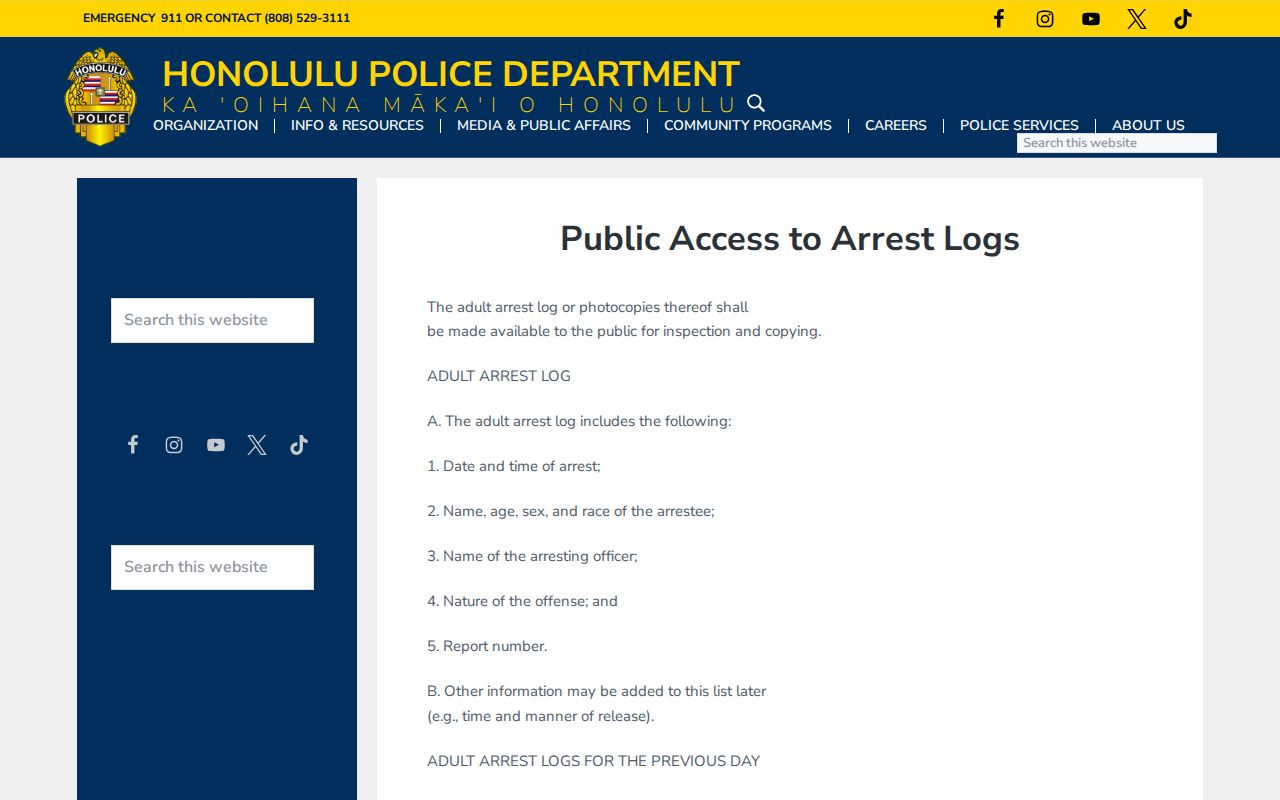
The policy view also shows why county routing matters. That example provides a current 14-day adult log, while older records require a request and juvenile arrests are excluded. It is illustrative, not a statewide replacement for each arresting agency's rules.
Requesting Hawaii Arrest Reports
No statewide portal collects every Hawaii police or incident report. Send the request to the agency that created and maintains the record. A clear request gives the report number if known, event date and place, involved names, and the precise document sought. Ask to inspect or receive a copy and choose a workable delivery format. The agency may charge search or duplication costs, so a cost estimate can prevent a broad request from becoming expensive.
The Hawaii Office of Information Practices forms page supplies the official UIPA request form and help with access disputes. OIP does not hold the police report and cannot produce another agency's records.
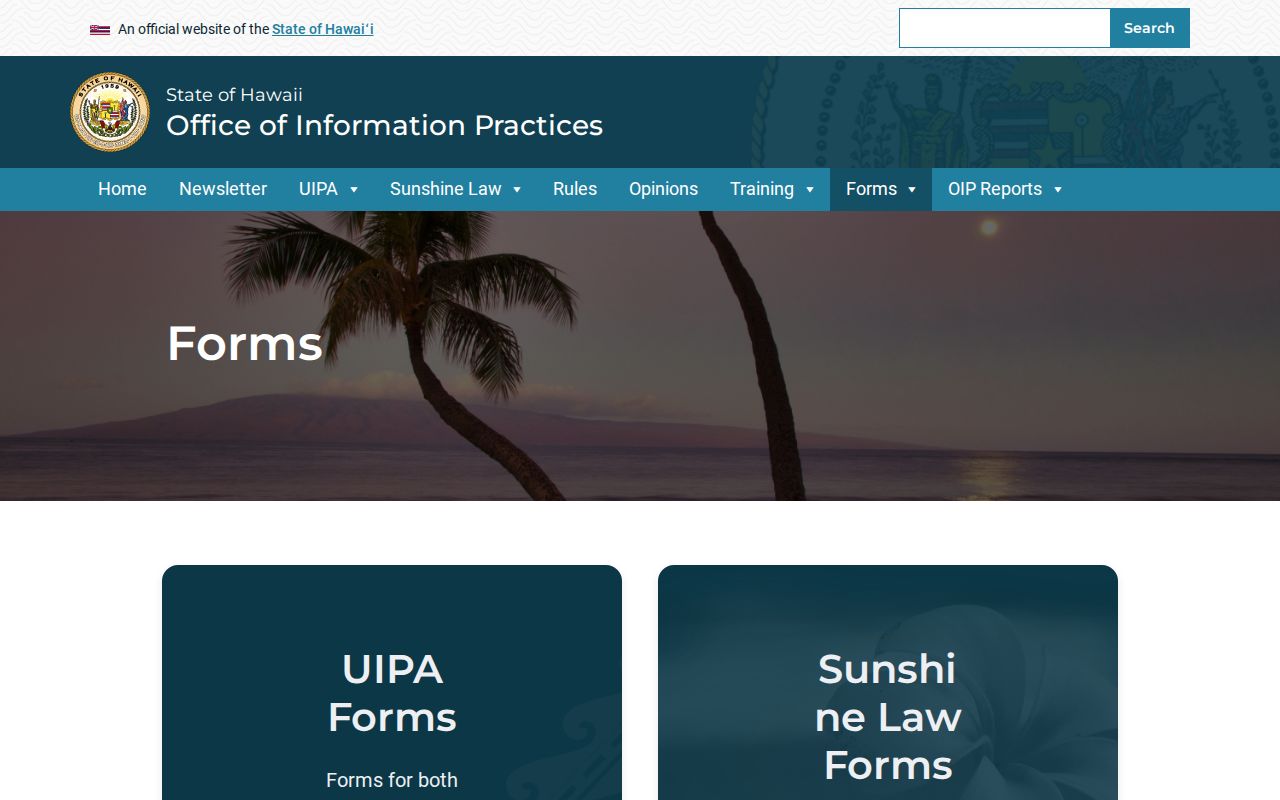
The form image reinforces the correct route: describe the record, select inspection or copying, and direct the request to the maintaining state or county office. Under HRS Chapter 92F, an agency can redact or withhold material for privacy, an active investigation, victim or juvenile protection, frustration of a legitimate government function, or another lawful restriction. Public access to an arrest log does not make every narrative, photograph, or evidence detail public.
Clearing Hawaii Arrest History
A qualifying non-conviction arrest does not vanish merely because time passed. Under HRS §831-3.2, a person arrested or charged but not convicted may apply to the Attorney General when the statutory conditions are met. Common endpoints include no charge, dismissal, or acquittal, subject to exclusions. HCJDC reviews the source records and, when approved, issues a certificate and removes eligible arrest information from public criminal-history dissemination.
Expungement and court sealing are separate. An HCJDC certificate does not automatically erase every public Judiciary document. Since July 1, 2025, Act 3 directs HCJDC to transmit qualifying orders for the Judiciary's separate electronic-record consideration, but multi-charge files and older records may still need court follow-up. Use the current June 2026 application, include the required ID, return envelope, and any applicable court order, then confirm both the HCJDC cycle and eCourt Kōkua entry after processing.
If your own arrest history is wrong, obtain HCJDC Access and Review, the police report, and a certified disposition. Match the OTN, SID, and case ID before challenging the source agency or HCJDC. That evidence-based route is more reliable than asking a portal to remove a record it does not control.
Arrests vs Convictions
An arrest is an accusation event. A conviction is a court judgment entered after a plea or verdict. Hawaii keeps this line clear in public access: an adult conviction may appear through eCrim, while ordinary pending and non-conviction arrest history in HCJDC is generally not public. The arresting agency may still release an adult log or other agency-held material under UIPA, subject to redaction and exemptions.
| Arrest record | Conviction record | |
|---|---|---|
| Created by | Police or another arresting agency, with DCR booking if detained | Hawaii State Judiciary judgment reported to HCJDC |
| What it proves | Custody, citation, or arrest was recorded on an allegation | Guilt was established by a plea or verdict on the stated count |
| Public access | Agency logs and reports under UIPA limits; repository non-conviction data is restricted | Nonconfidential court data and public adult conviction information through eCrim |
| Relief path | Qualifying non-conviction information may be expunged under HRS §831-3.2 | Relief is narrower and depends on the judgment and law that applies |
Note: A Hawaii arrest without a disposition is not proof of guilt; verify the case in the circuit that entered the final result.